Short answer: Repair a heat pump when it's under about ten years old, the failed part is minor, and it still keeps the house comfortable. Replace it when it's past 12 to 15 years, uses R-22, needs a compressor or coil, or has needed repeated repairs. Weigh the repair quote against the unit's age and replacement cost.
Almost every week somebody asks Jesse the same question while he's still kneeling next to their outdoor unit: "Is this thing worth fixing?" It's a fair question, and the honest answer is that it depends on a handful of facts you can actually check. We'd rather walk you through them than hand you a sales pitch.
Our default is simple. If a repair makes sense, we'll say so, and there's no pressure to replace what can be repaired. But a heat pump works harder in central North Carolina than a straight air conditioner does, because it runs in summer and winter, and there comes a point where another repair is just money spent on borrowed time.
How Long Heat Pumps Last in the Piedmont
A heat pump in our area typically gives 10 to 15 years of useful service. That range is wide because install quality, sizing, and maintenance swing it a lot. A properly charged, correctly sized unit on a level pad with clean coils can go past 15. An oversized unit that short-cycles, sits in a flower bed full of mulch, and never gets its coil rinsed may be struggling by year eight.
Keep in mind the year-round workload. Your heat pump runs through July humidity and then turns around and runs through January mornings in the 20s, cycling through defrost along the way. That's roughly twice the annual run hours of an AC-only system, so age matters more.
Five Questions That Usually Settle It
1. How old is the unit?
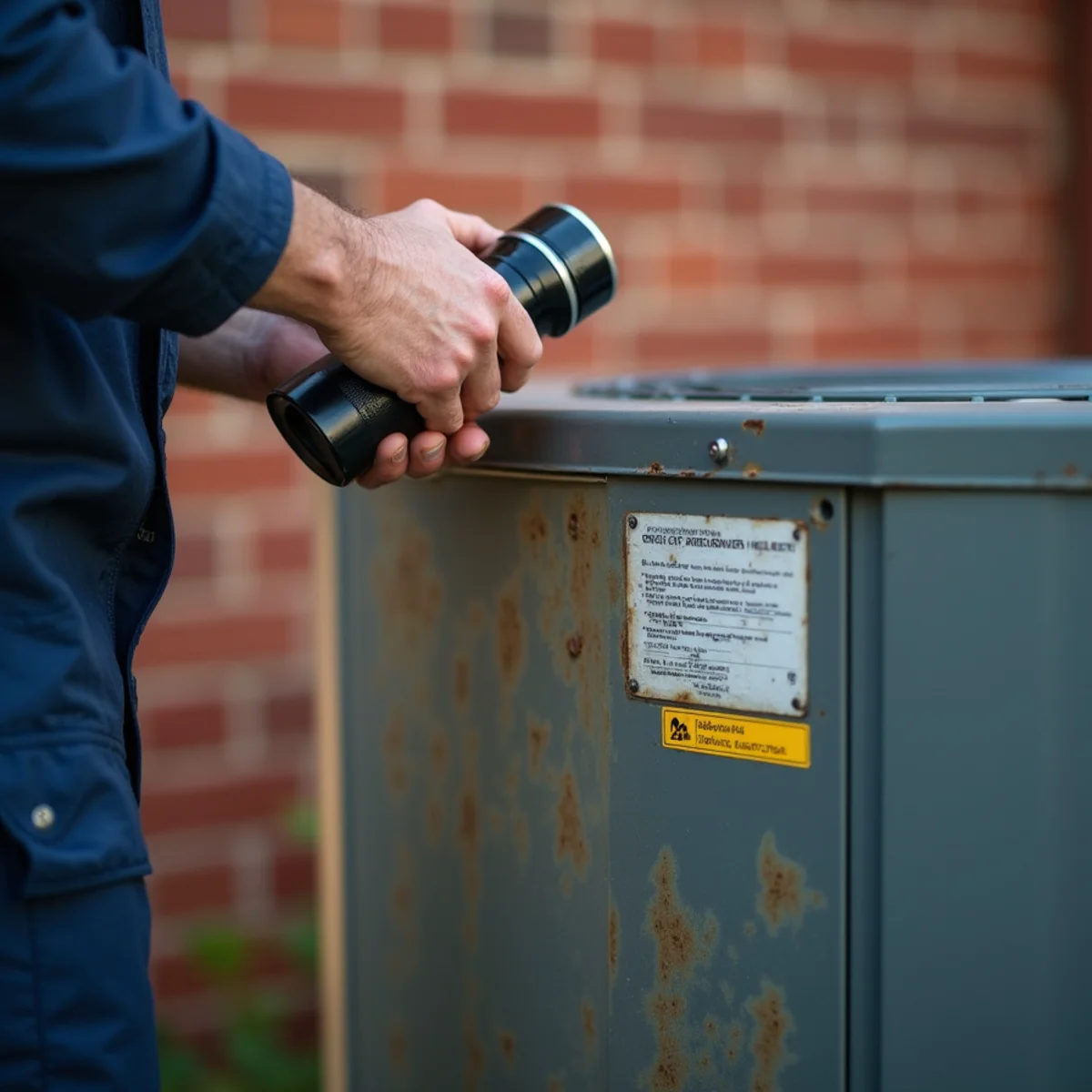
Check the data plate on the outdoor unit. The manufacture date is often coded into the serial number, and we can decode it for you. Anything under about eight years is usually a repair conversation. Past 12, we start looking hard at the rest of the list.
2. What refrigerant does it use?
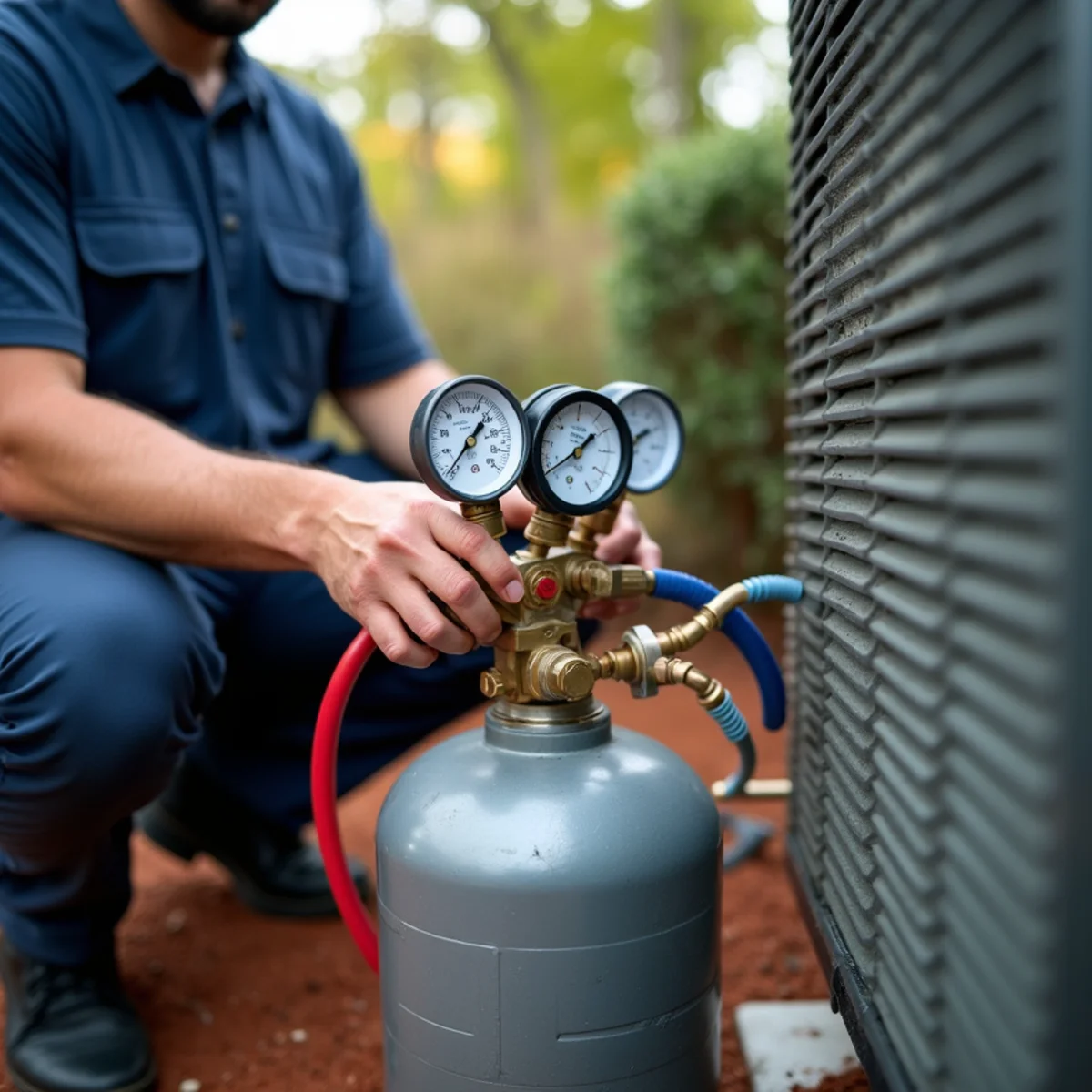
If the data plate says R-22, that matters a great deal. Production and import of R-22 ended in the U.S. in 2020, so any refrigerant for those systems comes from reclaimed stock, and the price reflects it. A leaking R-22 heat pump is rarely worth recharging more than once. Newer systems are also moving to lower-impact refrigerants, which is worth knowing if you're weighing a partial replacement.
3. Which part failed?
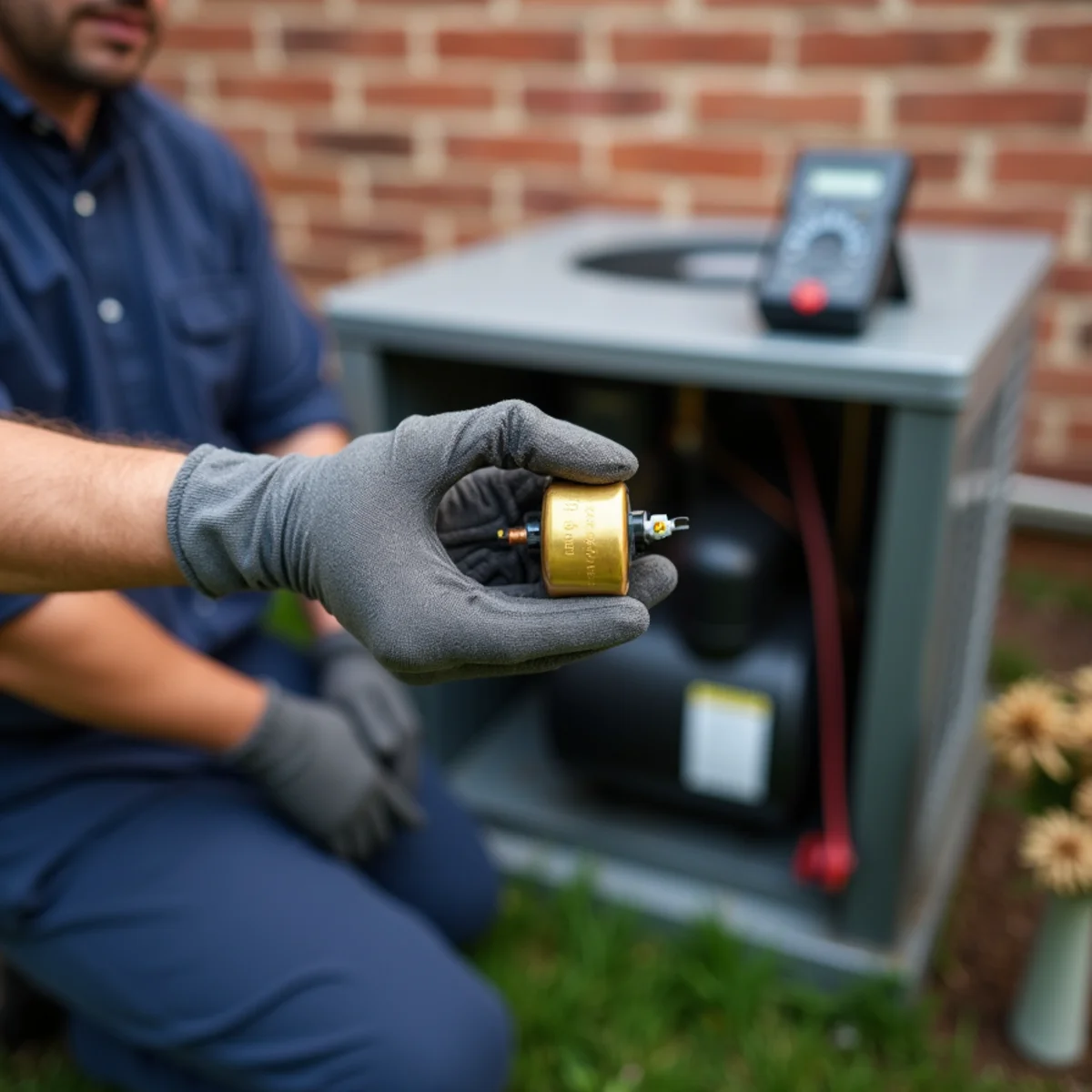
A $20 part and a compressor are not the same conversation. Capacitors, contactors, defrost sensors, and fan motors are routine repairs on a unit of almost any age. Compressors, reversing valves, and outdoor coil leaks are the big three that push an older system toward replacement.
4. What's the repair history?

One repair in ten years is normal wear. Three service calls in two seasons usually means the system is telling you something. If you've been adding refrigerant every spring, the leak didn't fix itself.
5. Is it keeping the house comfortable?
Some systems still run but never quite catch up: backup heat strips kicking on constantly, rooms that stay sticky in August, electric bills creeping up year over year. A repair won't fix a unit that was undersized or mismatched from day one.
Common Heat Pump Repairs and How We Weigh Them
| Failed component | Unit under ~8 years | Unit over ~12 years |
|---|---|---|
| Run capacitor or contactor | Repair | Repair |
| Defrost board or sensor | Repair | Usually repair |
| Outdoor fan motor | Repair | Repair, but check overall condition |
| Reversing valve | Repair, often under parts warranty | Often replace |
| Outdoor coil leak | Repair or coil swap | Usually replace, especially on R-22 |
| Compressor | Check warranty first | Replace in most cases |
On newer units, always ask whether the manufacturer's parts warranty still applies. Many require registration within a set window after install, and a covered compressor changes the math completely, even if labor isn't included.
What Replacement Actually Involves
If replacement makes sense, don't just swap the box. A good heat pump installation or replacement starts with a Manual J load calculation, a look at the ductwork, and a check of the electrical circuit and line set. Plenty of older homes had heat pumps sized by rule of thumb, and going bigger is not automatically better in our humid summers.
For budgeting, published Burlington-area planning ranges put heat pump installation somewhere around $6,500 to $11,850. Those are general market figures, not our prices, and your written quote will depend on capacity, efficiency rating, air handler condition, and duct work. Our page on full HVAC system installation explains what moves that number.
If you only need to condition an addition or a converted garage, a ductless mini-split can sometimes do the job for less than extending ducts.
A Note for McLeansville and East Guilford Homeowners
We cover HVAC service in McLeansville, just a short run up I-85/I-40 from our Burlington base, where a lot of homes built in the 1990s and early 2000s are on their second or even original heat pump. Many of those original units are R-22 systems, so if yours is original to the house, the refrigerant question alone may settle it.
Aging heat pumps: myths that cost homeowners money
Myth: A heat pump that runs nonstop on cold mornings is failing.
Fact: Long cycles are normal when it's in the 20s outside. A heat pump delivers steady, moderate heat rather than a furnace's blast, so supply air can feel lukewarm to your hand while the house holds setpoint. Worry instead when the auxiliary heat light stays on during mild weather, ice never clears between defrost cycles or the house steadily loses ground.
Myth: If the old unit still runs, keeping it doesn't cost anything.
Fact: A worn heat pump loses capacity quietly. Matted coils, a slow leak or a tired compressor mean the electric backup strips cover more of the heating load, and strips use far more electricity for the same heat than a healthy heat pump does. Rising winter bills with no change in habits are often an old system's running cost showing up.
Myth: Replacing the heat pump means replacing all the ductwork too.
Fact: Sound ducts can usually stay. We measure static pressure, look at the condition of the runs and check return sizing, then reuse what passes after sealing. Only crushed, wet or undersized sections need replacing. Skipping that test is the real mistake, because a new heat pump connected to a restricted duct system inherits the same airflow problems as the old one.
Myth: A brand-new heat pump won't need any attention for years.
Fact: First-year problems are usually installation problems: a charge that was never verified, auxiliary heat staging left at factory settings, a loose connection or a condensate line without proper slope. Ask for the startup readings in writing, keep up with filters and schedule a checkup before the first full heating season. Early fixes protect the compressor for the long run.
Repair-or-replace decisions in McLeansville
Much of McLeansville was built in the 1990s and 2000s, nearly all of it all-electric, so a large share of heat pumps in the 27301 ZIP are reaching the same age at once. That makes the questions above very practical there.
- Original R-22 units: a leak on one of these usually ends the repair conversation, since the refrigerant is no longer produced.
- Sticking reversing valves: solenoids on twenty-year-old valves often stick after idle months, and testing the coil first can save a valve replacement.
- January power bills: worn units lean on backup strips, so we amp-check each strip and the outdoor lockout before calling the heat pump done.
- Bonus rooms: homes with added space often do better with a single ductless head than with an oversized replacement for the whole house.
Crawlspace ranches here also sweat their supply ducts in summer, which matters if you replace, since new equipment deserves dry ducts. We reach heat pump owners in McLeansville in about 20 minutes on US-70 or I-40/85, including the neighborhoods off Huffine Mill Road and Knox Road, and cover the rest of eastern Guilford County on the same run.
From the field: confirm the verdict before you pay for it
A "bad compressor" diagnosis is the one we double-check most. A compressor that won't start can have a failed start capacitor, a burned wire at the terminal, or a tripped internal overload that resets once it cools. Jesse reads the windings with a meter and checks for a short to ground before calling it dead. More than once that check has turned a replacement conversation into a repair.
Reversing valves get misjudged too. A valve stuck between heat and cool sometimes needs a failed solenoid coil, not a new valve, and the coil is a far smaller repair.
The refrigerant question in 2026
New heat pumps now ship with A2L refrigerants such as R-454B. That doesn't make your R-410A unit obsolete; R-410A is still available for service. It only matters when a big failure forces the choice, because a new outdoor unit usually means a matching new indoor coil or air handler too.
- Worth repairing: capacitors, contactors, defrost boards, fan motors, a solenoid coil.
- Worth a second opinion: any compressor or reversing valve verdict on a unit under ten years old.
- Usually time to replace: a leaking R-22 system, or a second major failure on an older unit.
Manufactured homes follow the same logic, with a few extra wrinkles on packaged units and duct connections; see our mobile home HVAC service.
Get a Straight Answer Before You Spend
- Write down the model and serial number from the outdoor unit.
- Note any repairs from the last three years and roughly what they cost.
- Keep an eye on your winter power bills and whether the "aux heat" light stays on.
- Ask for written options: repair cost, replacement cost, and what each one buys you.
Jesse will test the system, tell you what failed and why, and put both paths in writing so you can decide without a clock ticking. If your old unit is acting up, schedule a heat pump diagnosis with Littlejohn HVAC and we'll help you figure out whether it's worth one more repair.
Frequently asked questions
Should I replace my heat pump if it still uses R-22?
Not automatically. If it's running well and not leaking, keep using it and maintain it. But if it develops a refrigerant leak or a major failure, replacement is usually the smarter spend because R-22 is no longer produced and recharging gets expensive fast.
Can I replace just the outdoor unit of a heat pump?
Sometimes, but it's rarely ideal. The indoor coil and outdoor unit are designed as a matched pair for efficiency and refrigerant compatibility. Mismatching them can void warranties and reduce performance. We'll tell you if a partial replacement is reasonable for your setup.
Is it worth repairing a heat pump compressor on a 12-year-old unit?
In most cases, no. A compressor replacement on an out-of-warranty unit that old often costs a large share of a new system, and the rest of the components are just as old. We'll price both options so you can compare.
Local service for this topic

Written by Littlejohn HVAC Solutions, LLC. Owner Jesse Littlejohn is a licensed HVAC professional serving Burlington and Alamance County. About us