Short answer: Home insurance in NC usually covers an AC or furnace only when a covered event causes sudden damage, such as lightning, fire, wind, a falling tree, theft or vandalism. It generally won't pay for wear and tear, rust, poor maintenance or ordinary mechanical breakdown. Floods need separate coverage, and equipment breakdown endorsements fill some gaps.
When a system dies, a lot of homeowners dig out their insurance policy before they call anyone. Sometimes that pays off. More often, the policy covers less than people hope. Knowing where the line usually falls saves you a wasted claim and a deductible surprise.
A quick disclaimer: we fix heating and cooling equipment, we don't interpret insurance contracts. Every policy is different, so your declarations page and your agent have the final word. What we can tell you is what we see in the field and how the damage gets documented.
The Core Rule: Sudden and Accidental vs. Wear and Tear
Most standard homeowners policies are built to cover sudden and accidental damage from a covered peril. They generally exclude gradual deterioration, mechanical breakdown, rust, and damage caused by lack of maintenance. That one distinction answers most HVAC coverage questions.
| What happened | Often covered? | Why |
|---|---|---|
| Lightning strike or power surge fries the control board | Often, if surge is a covered peril | Sudden event from an outside cause |
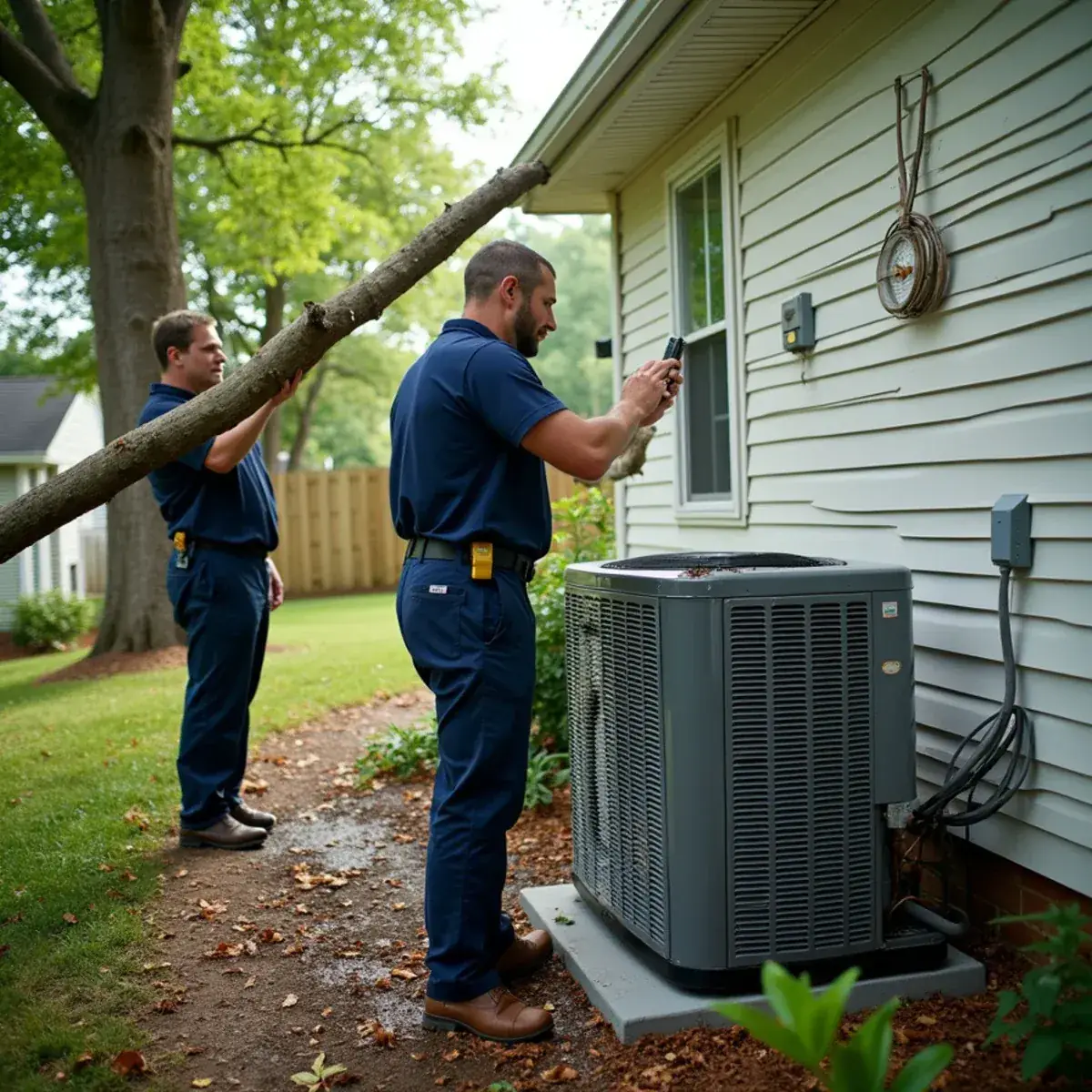
| Tree limb crushes the outdoor unit in a storm | Often | Wind and falling objects are common covered perils |
| Fire damages the furnace or air handler | Often | Fire is a standard covered peril |
| Condenser stolen or vandalized for copper | Often | Theft and vandalism are commonly covered |
| Compressor wears out after 14 years | Rarely | Wear and tear or mechanical breakdown |
| Refrigerant leak from a corroded coil | Rarely | Gradual deterioration |
| Flood water submerges the unit | Not under a standard policy | Flood usually requires a separate flood policy |
Gray Areas We See in Guilford and Alamance Counties
Surge damage after summer storms
Afternoon thunderstorms roll through the Triad all summer. After a close lightning strike, we'll sometimes find a burned contactor, a blown control board, or a failed compressor. Whether that's covered depends on your policy's wording and on whether the tech can document evidence of an electrical event rather than simple age. We'll write down exactly what we found.
Water damage from a clogged condensate line
An overflowing drain pan can soak a ceiling or subfloor. Some policies may cover the resulting water damage to the house while excluding the clogged drain and the HVAC repair itself. Long-term leaks that were ignored are usually excluded.
Ice storm outages
Insurance generally doesn't pay because the power went out and the house got cold. It may respond if something physically damaged the equipment, such as ice-laden limbs falling on the condenser or a surge when power returned.
Home Warranties Are a Different Animal
A home warranty is a service contract, not insurance. It's designed for the exact thing insurance excludes: normal breakdowns from age and use. Coverage caps, service fees, pre-existing condition clauses, and maintenance requirements vary widely, and many limit which contractor you can use. Read the contract before you need it.
Your equipment may also still have a manufacturer's parts warranty, which is separate from both. Ask us to check the serial number; if a covered part failed, that's often the fastest path.
Some insurers also sell an optional equipment breakdown endorsement that covers mechanical and electrical failures of home systems. If you want that protection, ask your agent whether it's available and what it excludes.
What to Do If You Think You Have a Claim
- Make the situation safe. Shut the system off at the thermostat if you smell burning or see water spreading.
- Take photos and video of the damage, the unit's data plate, and anything that caused it, like a fallen limb.
- Call your insurance agent or carrier to report it and ask how they want it handled.
- Get a written diagnosis from a licensed HVAC contractor stating the cause as clearly as the evidence allows.
- Keep receipts for any emergency repairs or temporary measures.
We'll give you an honest written assessment. If the failure looks like age and wear, we'll say that too, because a report that stretches the truth can hurt you later.
Maintenance Records Can Matter
Insurers and warranty companies both look at whether a system was reasonably cared for. A policy exclusion for neglect, or a warranty clause requiring annual service, can turn a routine failure into a denied claim. Keeping a simple folder of service invoices costs you nothing and can settle a dispute quickly.
- Save every service invoice with the date, the technician's findings, and parts replaced.
- Photograph the outdoor unit's data plate and keep the model and serial numbers somewhere you can find them.
- Note the install date and who installed the system, since warranty terms often depend on it.
- Write down the date and time of any storm, outage, or surge that preceded a failure.
None of this guarantees coverage, but it gives your adjuster or warranty administrator facts instead of guesses.
HVAC insurance claims: myths vs. facts
Myth: Any AC that fails after a thunderstorm was damaged by lightning.
Fact: Summer storms arrive on the hottest, hardest-working afternoons, which is also when worn capacitors and tired compressors give out. Timing alone doesn't prove a surge. Adjusters look for physical evidence, and a technician's report has to match what's actually in the unit. If the failure looks like age, a claim built only on the storm date is likely to be denied.
Myth: Filing a claim that gets denied has no downside.
Fact: Claims, and sometimes even inquiries, can be recorded in industry loss-history databases that insurers review when they price or renew a policy. Practices vary by carrier. Before you report a small loss, ask your agent how the company treats claims that end up denied or below the deductible, and weigh that answer against the repair estimate in hand.
Myth: Insurance won't pay for anything if the system was already old.
Fact: Age alone doesn't block coverage for sudden damage. An aging condenser crushed by a falling limb is still storm damage. What age changes is the payout: many policies pay actual cash value, which subtracts depreciation, while replacement cost coverage pays closer to what a new equivalent costs. Your declarations page shows which kind you have.
Myth: If the old unit is damaged, insurance will pay for an upgraded system.
Fact: Policies generally pay to repair or replace with equipment of like kind and quality, not an upgrade. The catch is that some older equipment can't be replaced exactly, such as an R-22 condenser, and code changes may require a matching indoor coil or new electrical work. Ask your adjuster how those required changes are handled before work begins.
Storm damage and claims across Guilford County
Afternoon thunderstorms roll across the Triad all summer, and Guilford County's big street trees put a lot of condensers within reach of falling limbs. What an adjuster sees depends on which part of the county you live in.
- Historic Greensboro homes in Fisher Park and Irving Park often have basements, so an overflowing drain can reach finished space quickly. Photograph the ceiling or floor before anyone starts drying it out.
- Eastern suburbs such as Whitsett, McLeansville and Forest Oaks still have original R-22 heat pumps. If one is storm-damaged, the like-kind question comes up right away, so raise it with your adjuster early.
- Newer homes near the Alamance line often run variable-speed equipment with electronic controls that are sensitive to surges and can show visible damage on the boards.
We reach eastern Guilford in about 15 minutes and most of Greensboro in 25 to 35. After a storm, our Guilford County HVAC service includes a written report of what failed and why, with the parts bagged for inspection.
From the field: how we tell a surge from old age
Adjusters want evidence, and the equipment usually has it. A surge tends to leave a pattern: a pitted or welded contactor, scorched traces on a control board, a blown low-voltage fuse, and often other electronics in the house that died the same afternoon. A compressor that reads shorted to ground right after a close strike tells a different story than one with years of oil staining at a slow leak.
Age leaves its own marks: corroded coil fins, rusted cabinets, repeated refrigerant top-offs on old invoices. When that's what we find, we write it down that way, because a report that stretches the truth can cause you bigger problems than a denied claim.
- Keep the failed parts. We bag and label them so an adjuster can see them.
- Report it promptly. Note the storm date and time while it's fresh.
- Photograph before cleanup. Limbs, scorch marks and water lines disappear fast.
Prevention costs less than a claim
A surge protector at the outdoor disconnect, or a whole-home unit installed by an electrician at the panel, won't stop a direct strike but handles the everyday spikes that come with Triad thunderstorms and ice-storm power flickers. Trimming limbs that hang over the condenser removes the most common physical damage we see. We check contactors, wiring and capacitors on every maintenance visit, which also builds the service record insurers ask about.
Local Help When You Need It
We provide AC repair and diagnostics across Alamance and into Guilford County HVAC service areas like Whitsett, McLeansville, and Greensboro. For heating failures, our furnace repair service covers gas furnaces and air handlers, and if storm damage leaves you without heat or cooling in dangerous weather, call about emergency HVAC repair.
If you need someone to document storm or surge damage, or just want to know whether the repair is even worth a claim, book an AC repair visit with Littlejohn HVAC and we'll give you the facts in writing.
If you have questions about how your insurer handled a claim, the North Carolina Department of Insurance has consumer resources that can help you understand your options.
Frequently asked questions
Does homeowners insurance cover an AC that just stopped working?
Usually not. Standard policies generally exclude mechanical breakdown and wear and tear. Coverage typically applies when a covered event, such as lightning, fire, a falling tree, or theft, caused the damage. Check your policy wording to be sure.
Will insurance pay for a furnace that failed during a cold snap?
If it failed from age or a worn part, probably not. If a covered event physically damaged it, such as a fire or a surge, it may be covered. A home warranty or manufacturer's parts warranty is more likely to help with ordinary breakdowns.
Can you write up the cause of damage for my insurance company?
Yes. We document what we find, including photos and the specific failed components, and describe the likely cause as honestly as the evidence supports. The insurer makes the coverage decision.
Local service for this topic

Written by Littlejohn HVAC Solutions, LLC. Owner Jesse Littlejohn is a licensed HVAC professional serving Burlington and Alamance County. About us